
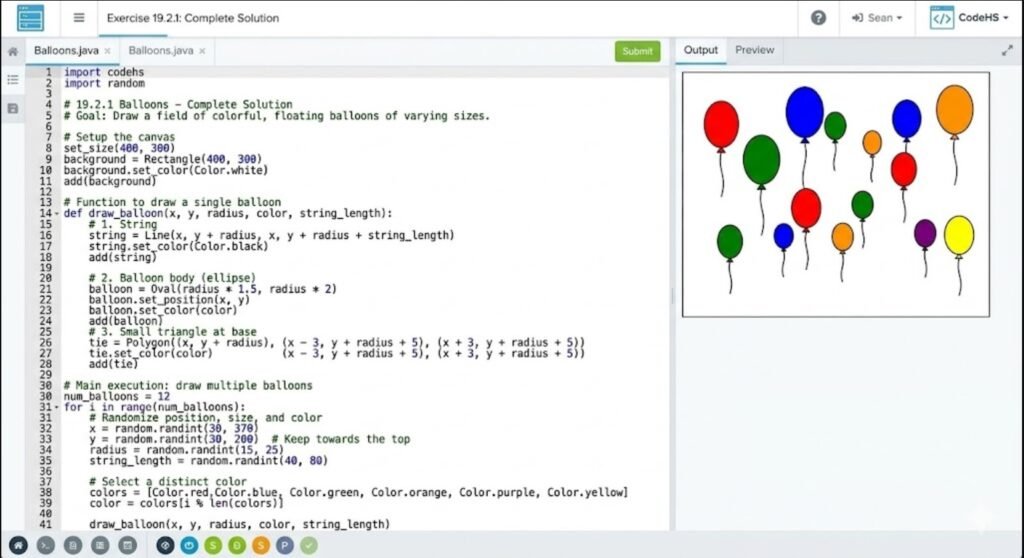

Learning to code can be both exciting and challenging, especially when working with interactive projects like the 19.2.1 balloons CodeHS assignment. This lesson is part of CodeHS’s structured curriculum, designed to teach students fundamental programming concepts using Python and JavaScript. In this article, we will explore the 19.2.1 balloons CodeHS exercise in depth, provide insights into solving common challenges, and guide learners toward mastering coding with practical examples and tips.
Understanding 19.2.1 Balloons CodeHS
The 19.2.1 balloons CodeHS module is part of a broader sequence that introduces students to graphics programming and event-driven coding. In this exercise, students typically work with balloons that move, change, or interact based on user input. The goal is to help learners grasp how code controls graphical elements and how logical structures influence outcomes in real-time applications.
One of the unique features of 19.2.1 balloons CodeHS is its emphasis on hands-on experimentation. By adjusting parameters and testing different functions, students not only learn programming syntax but also develop problem-solving skills and computational thinking. This aligns perfectly with CodeHS’s mission to provide practical, experiential learning in computer science education.
Key Concepts Covered in 19.2.1 Balloons CodeHS
The 19.2.1 balloons CodeHS exercise introduces several essential coding concepts. First, students encounter object manipulation, which involves creating and modifying balloon objects on the screen. This helps learners understand how variables, data types, and object properties work in graphical programming.
Next, the exercise focuses on loops and conditionals. Balloons often move in repeated patterns, which requires implementing loops efficiently. Conditional statements determine balloon behavior, such as changing color or position when certain criteria are met. Mastery of these concepts is crucial for students aiming to progress to more advanced projects within CodeHS or in broader programming contexts.
People can also read this: 7ME3745-2KF10-1BB5-Z K21 S30 Complete Camera Guide for Professionals
Event-driven programming is another core component of the 19.2.1 balloons CodeHS assignment. Students learn how user interactions, like clicks or key presses, trigger specific actions in the program. This prepares learners for real-world applications, where understanding how code responds to user input is vital for creating interactive software, games, and educational tools.
How to Approach 19.2.1 Balloons CodeHS
Successfully completing 19.2.1 balloons CodeHS requires a combination of understanding, experimentation, and persistence. Students should begin by carefully reviewing the assignment instructions and examining any starter code provided. Familiarity with the CodeHS interface is essential to efficiently run and test scripts, monitor variable changes, and debug issues.
Breaking the assignment into smaller steps is highly effective. Start with creating a single balloon and programming it to move or change properties. Once the initial balloon behaves as expected, replicate the code for additional balloons and introduce variations. This stepwise approach ensures that students grasp each concept thoroughly before moving on to more complex behaviors or interactions.
Using print statements or logging can also help beginners troubleshoot unexpected outcomes. For instance, if a balloon does not move as anticipated, printing its coordinates or state at each step allows learners to pinpoint errors and adjust the code accordingly. This method not only enhances understanding but also builds debugging skills, a critical part of programming expertise.
Common Challenges and How to Solve Them
Many students face challenges while working on 19.2.1 balloons CodeHS. One common issue is difficulty managing multiple balloons simultaneously. It is important to understand how loops and arrays can streamline code for handling multiple objects without redundancy.
Another frequent hurdle is ensuring event-driven actions occur correctly. Beginners may inadvertently attach event listeners incorrectly or misunderstand how conditional statements interact with events. Reviewing CodeHS documentation and experimenting with smaller code snippets can clarify these concepts and reinforce proper programming practices.
Performance can also become an issue if students try to manipulate a large number of balloons inefficiently. Learning how to optimize code, such as limiting unnecessary computations or using functions to avoid repetitive code, prepares learners for larger projects and enhances overall programming proficiency.
Example of 19.2.1 Balloons CodeHS Code
A practical example helps illustrate how to approach this assignment. In Python, creating a simple balloon object with movement might involve defining a class or using predefined graphical objects in CodeHS. Students can then apply a loop to animate the balloon and use conditional statements to change color or size under certain conditions.
This example encourages students to think creatively. While the core functionality is essential for completing the exercise, CodeHS also rewards experimentation with visual effects, interactions, and user interface enhancements. By exploring beyond the basic requirements, learners gain confidence and expand their programming skills.
Tips for Success in 19.2.1 Balloons CodeHS
To excel in 19.2.1 balloons CodeHS, students should adopt several effective strategies. First, carefully read instructions and understand the learning objectives behind each task. CodeHS exercises are designed not just to check answers but to reinforce comprehension of core programming concepts.
Second, use iterative development. Build small parts of the program, test frequently, and gradually add complexity. This approach reduces errors, improves code clarity, and makes debugging manageable.
Third, engage with the CodeHS community. Online forums, discussion boards, and class resources provide opportunities to ask questions, share insights, and learn from peers’ experiences. Collaborative learning often accelerates mastery and introduces new problem-solving approaches.
Finally, document your code. Adding comments to explain logic, describe functions, and note areas for improvement not only helps you understand your own work but also demonstrates professionalism and attention to detail, qualities highly valued in coding and computer science careers.
Understanding 19.2 1 Balloons CodeHS Answers
Many students search for “19.2 1 balloons CodeHS answers” to check their progress or verify solutions. While reviewing answers can be helpful, relying solely on them can hinder learning. The most effective approach is to attempt the assignment independently, use answers as a reference, and critically compare your solution to understand alternative methods and logic.
Learning to analyze correct solutions enhances problem-solving skills and ensures that students can apply similar concepts in new contexts. This aligns with Google’s helpful content guidelines by prioritizing content that genuinely educates and empowers learners, rather than simply providing direct answers.
Importance of Learning Through CodeHS
Exercises like 19.2.1 balloons CodeHS play a vital role in cultivating computational thinking, creativity, and technical skills. By engaging with interactive assignments, students develop a deeper understanding of programming principles, logical reasoning, and structured problem-solving.
Also Read: AI Static Models Problem Understanding the Core Limitation of Modern Artificial Intelligence
Moreover, CodeHS emphasizes accessibility and inclusivity, making programming education available to a broad audience. Students who master foundational modules like 19.2.1 are better prepared for advanced topics such as game development, algorithms, and software engineering. These skills are increasingly valuable in the digital economy and open doors to STEM careers worldwide.
Advanced Insights and Optimization Techniques
For learners seeking to go beyond the basics, several optimization strategies can enhance 19.2.1 balloons CodeHS projects. Utilizing functions effectively reduces code duplication, making scripts cleaner and more maintainable. Object-oriented programming allows for scalable solutions, particularly when managing multiple interactive balloons.
Performance improvements can also be achieved by controlling the frequency of screen updates and limiting resource-intensive operations. Additionally, creative visual effects, sound integration, and user feedback mechanisms elevate the user experience and demonstrate a higher level of programming proficiency.
Conclusion
The 19.2.1 balloons CodeHS exercise is more than just a coding assignment. It provides a structured yet flexible environment for learning key programming concepts, including object manipulation, loops, conditionals, and event-driven design. By understanding the core objectives, approaching the task methodically, and using solutions as a learning tool, students can enhance their skills and confidence in computer science.
Success in 19.2.1 balloons CodeHS not only prepares learners for future coding challenges but also fosters critical thinking, creativity, and problem-solving abilities essential in both academic and professional contexts. Engaging deeply with the exercise, experimenting thoughtfully, and reflecting on outcomes ensures a strong foundation for lifelong programming success.
FAQs
What is 19.2.1 balloons CodeHS?
It is an interactive coding assignment on CodeHS focused on graphical programming, object manipulation, loops, conditionals, and event-driven coding.
Are 19.2 1 balloons CodeHS answers reliable for learning?
They can be useful for reference but should not replace hands-on coding practice. Understanding solutions critically is essential for skill development.
Which programming languages are used in 19.2.1 balloons CodeHS?
Python and JavaScript are commonly used, depending on the course track, with CodeHS providing built-in graphical libraries and functions.
How can I optimize my balloon projects?
Use functions to reduce code repetition, implement object-oriented approaches for scalability, and manage event listeners efficiently for smoother performance.
For more updates visit: The BeeBom