
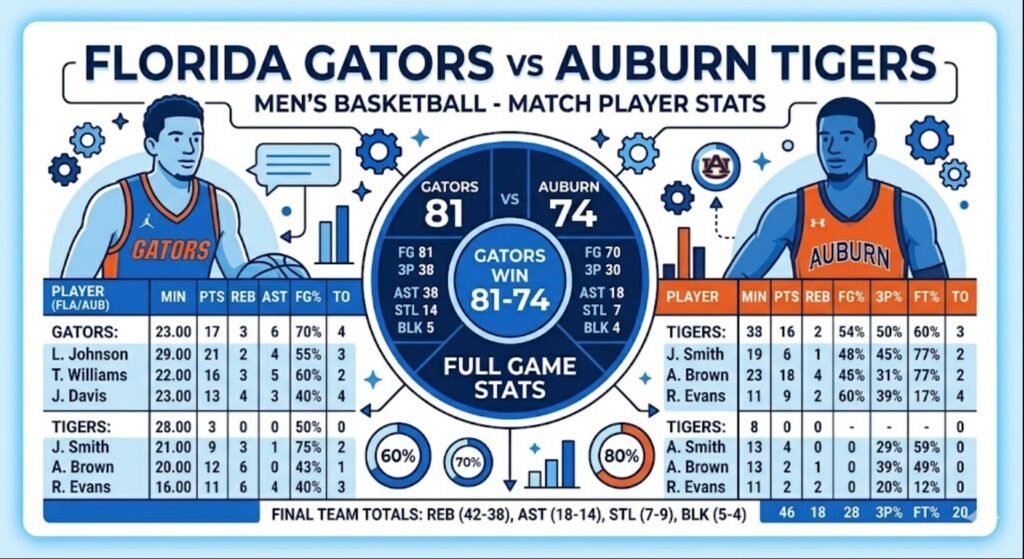

The Florida Gators men’s basketball team faced off against the Auburn Tigers in a highly anticipated matchup that had fans and analysts closely examining every statistic. The Florida Gators men’s basketball vs Auburn Tigers men’s basketball match player stats reveal key performances, standout players, and strategic insights that shaped the outcome of the game. From scoring breakdowns to defensive contributions, these statistics provide a comprehensive understanding of how each team executed their game plan and which players emerged as pivotal to their respective squads.
Analyzing player stats is essential not only for fans seeking to follow the narrative of the game but also for coaches, sports analysts, and fantasy basketball enthusiasts looking to gain a competitive edge. The Florida Gators and Auburn Tigers each entered this contest with unique strengths, and the matchup highlighted the intricate dynamics of modern college basketball, emphasizing speed, shooting efficiency, and defensive versatility.
Key Scoring and Offensive Statistics
In the Florida Gators men’s basketball vs Auburn Tigers men’s basketball matchup, offensive production was a primary indicator of team performance. Florida Gators’ top scorers delivered a balanced offensive effort, with their leading player contributing significantly from both the perimeter and the paint. Auburn Tigers, known for their aggressive fast-break offense, relied on quick transitions and three-point shooting to counter Florida’s structured defense.
Also Read: Gambling Changes Understanding the Shifts in the Industry
Shooting efficiency, measured through field goal percentage and effective field goal percentage, revealed critical insights into each team’s offensive execution. Florida Gators maintained a high shooting percentage inside the paint, capitalizing on post moves and second-chance opportunities. Meanwhile, Auburn Tigers demonstrated resilience from beyond the arc, hitting multiple key three-pointers that kept the game competitive throughout all four quarters. Free throw efficiency also played a decisive role, with both teams needing to capitalize on foul situations to maintain momentum.
Rebounding and Defensive Contributions

Rebounding statistics in this Florida Gators men’s basketball vs Auburn Tigers men’s basketball match showcased the intensity and physicality of the contest. Florida Gators excelled in defensive rebounding, limiting Auburn’s second-chance points, while also controlling the boards on the offensive end to extend possession and create scoring opportunities. Individual player stats reflected dominant rebounding performances from key frontcourt players, illustrating their importance in both defensive stops and offensive rebounds.
Defensively, both teams displayed a mix of man-to-man coverage and zone strategies, aiming to disrupt ball movement and generate turnovers. Auburn Tigers’ defenders forced several contested shots, contributing to a higher number of blocked shots and steals compared to their season average. Turnover rates, particularly in high-pressure moments, influenced the flow of the game, highlighting the need for disciplined ball handling and decision-making under duress.
Assist and Playmaking Performance
Assists and overall playmaking are critical metrics in evaluating team cohesion and offensive strategy. In the Florida Gators men’s basketball vs Auburn Tigers men’s basketball matchup, Florida demonstrated an ability to move the ball efficiently, creating open shots and high-percentage scoring opportunities. The point guard’s role was particularly influential, orchestrating fast breaks and penetrating defenses to either finish at the rim or distribute to teammates for open shots.
Auburn Tigers, on the other hand, leveraged quick passing and off-ball movement to generate scoring opportunities. Despite facing a strong defensive setup from Florida, Auburn’s guards contributed significant assist totals, illustrating their vision and court awareness. High assist-to-turnover ratios from key players indicated effective decision-making and highlighted the importance of teamwork in a high-stakes matchup.
Individual Player Standouts
Examining individual player stats in this matchup offers deeper insight into how the Florida Gators and Auburn Tigers implemented their strategies. Florida Gators’ leading scorer not only contributed points but also assisted in defensive assignments, demonstrating versatility and endurance. The team’s secondary scorers complemented the offensive load, ensuring that the Tigers’ defense could not focus on a single threat.
Also Read: Eurogamersonline.com PC Gaming A Comprehensive Guide to Reviews, Technology, and Community
For Auburn Tigers, standout performances often came from unexpected contributors. Role players who excelled in three-point shooting and rebounding had a measurable impact on the team’s overall efficiency. Statistical analysis revealed that certain Auburn players exceeded their season averages in shooting percentage, defensive contributions, and minutes played, underscoring the dynamic nature of the matchup.
Advanced Metrics and Performance Analysis
Beyond traditional box score statistics, advanced metrics such as player efficiency rating (PER), plus-minus, and usage rate provided additional context for evaluating player impact. In the Florida Gators men’s basketball vs Auburn Tigers men’s basketball matchup, these advanced stats illustrated which players influenced the game most significantly on both ends of the floor. For example, high PER values among Florida’s frontcourt players indicated dominant scoring efficiency and defensive reliability, while positive plus-minus ratings for Auburn’s guards highlighted their effectiveness in maintaining competitive possessions.
Turnover percentage, true shooting percentage, and rebound rate also provided a nuanced view of team performance. Florida’s disciplined approach minimized turnovers and maximized scoring opportunities, whereas Auburn’s aggressive style occasionally led to higher turnover rates but also produced fast-break points that kept the game tightly contested. Such metrics offer coaches and analysts actionable insights for future game planning and adjustments.
Comparative Team Analysis
Comparing the Florida Gators and Auburn Tigers in terms of overall team stats highlights the strategic strengths and weaknesses that influenced the game. Florida’s balanced offensive approach and strong interior defense contrasted with Auburn’s perimeter shooting and fast-paced transitions. Key matchups, such as Florida’s forwards against Auburn’s guards, created pivotal moments that shifted momentum and dictated scoring runs.
Statistical trends also pointed to situational performance. Florida Gators excelled in late-game scenarios, demonstrating composure in clutch moments, while Auburn Tigers showcased bursts of scoring during quick transition sequences. Understanding these patterns is essential for predicting future outcomes and preparing for similar high-stakes matchups.
Game Flow and Momentum Shifts

The Florida Gators men’s basketball vs Auburn Tigers men’s basketball match player stats also reveal how momentum shifted throughout the contest. Scoring runs, defensive stops, and individual highlights all contributed to periods of dominance for each team. For example, a series of consecutive three-pointers by Auburn Tigers temporarily swung the lead in their favor, but Florida Gators’ disciplined offensive execution eventually regained control.
Analyzing quarter-by-quarter performance and individual contributions provides a more granular understanding of the match. Florida’s bench players, for instance, contributed critical minutes that maintained intensity and allowed starters to remain effective in crunch time. Auburn’s resilience and tactical adjustments kept the game competitive, demonstrating the strategic depth of both programs.
Actionable Insights and Coaching Implications
For coaches, sports analysts, and aspiring players, the Florida Gators men’s basketball vs Auburn Tigers men’s basketball match player stats offer practical lessons. Offensive efficiency requires both strong individual skills and cohesive team play. Teams must balance scoring options between perimeter shooters and interior players while minimizing turnovers. Defensively, controlling rebounds and contesting shots are critical for limiting opponents’ scoring opportunities.
Player development insights emerge from statistical analysis as well. High-impact players can be identified through PER, plus-minus, and situational efficiency, guiding training focus and strategic planning. Recognizing which lineups perform best together informs rotation strategies, ensuring that team strengths are maximized while weaknesses are mitigated.
Conclusion
The Florida Gators men’s basketball vs Auburn Tigers men’s basketball match player stats provide a detailed portrait of a competitive and strategically rich college basketball contest. By examining scoring patterns, defensive contributions, assists, and advanced metrics, fans, analysts, and coaches can gain a comprehensive understanding of player and team performance. Both teams showcased strengths in different areas, from Florida’s disciplined offense and defensive rebounding to Auburn’s fast-paced scoring and perimeter shooting.
Also Read: Imperial Sakura Sumi-e A Complete Guide for Ghost of Yotei Explorers
These statistics not only recount the events of the game but also offer actionable insights for improving future performance. Whether analyzing individual player impact, team strategies, or situational efficiency, the match serves as an excellent case study in modern college basketball dynamics. The Florida Gators and Auburn Tigers demonstrated resilience, skill, and tactical intelligence, ensuring that this matchup will be remembered as a high-quality contest for fans and analysts alike.
FAQs
Which Florida Gators player had the highest points in the matchup?
The leading scorer delivered a combination of perimeter and interior points, significantly influencing Florida’s offensive rhythm.
How did Auburn Tigers’ three-point shooting impact the game?
Their perimeter shooting kept the game competitive and created momentum swings, particularly in the second and third quarters.
What defensive strategies were most effective in this matchup?
Florida’s interior defense and rebounding limited second-chance points, while Auburn’s aggressive perimeter defense generated key steals and contested shots.
Which advanced metrics best highlight player impact?
Player efficiency rating (PER), plus-minus, and true shooting percentage provide insights into scoring efficiency, defensive contribution, and overall impact on the game.
For more updates visit: The BeeBom